Bitcoin reached $61,200 on November 23, 2026, after trading as low as $55,112 over the weekend. Ether rose to $1,718 from $1,536 on November 21. Algorand (ALGO), Jupiter (JUP), Quant (QNT) and Internet Computer (ICP) were among the largest gainers.
Crypto trading volume exceeded $133 billion over 24 hours. Futures open interest rose 0.3% to $104 billion, while liquidations fell by more than 61% to $165 million.
The rebound extended beyond crypto
U.S. equity futures also rose: Dow futures gained more than 900 points, S&P 500 futures rose 176 points and Nasdaq 100 futures added 800 points. The VIX volatility index fell 10%.
Brent crude fell 1.52% to $88.55 a barrel, and West Texas Intermediate fell to $82.11. Invezz attributed the oil decline to the absence of renewed fighting between the United States and Iran over the weekend, although Iran had signaled it might send a tanker convoy to challenge the U.S. blockade.
U.S. Treasury yields fell to 4.74% for the five-year note, 4.9% for the ten-year note and 5.32% for the 30-year bond. Invezz interpreted the declines as a sign that investors saw less likelihood of a half-percentage-point interest rate increase. Some investors had priced in an increase of that size after Christopher Waller indicated he would support it.
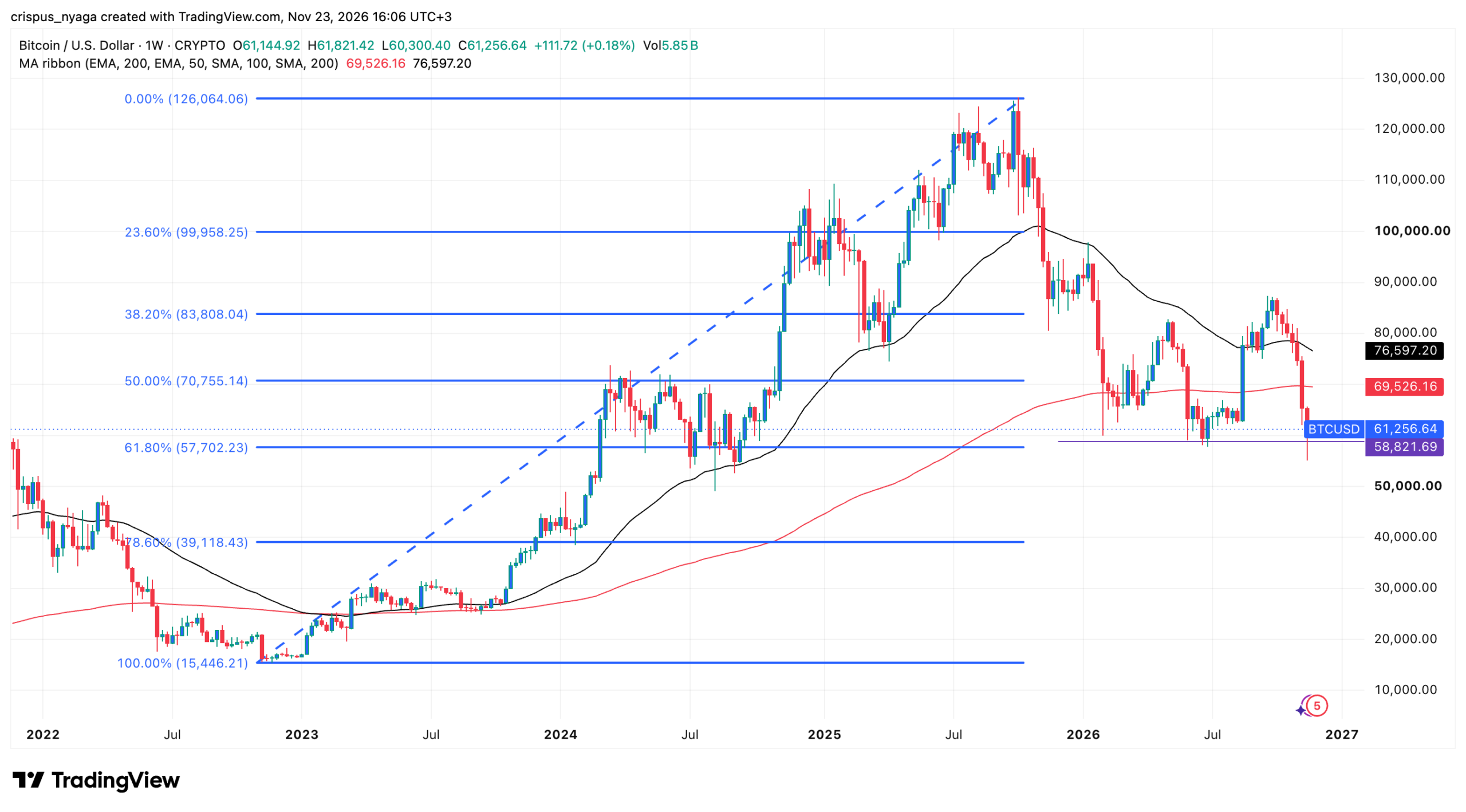
Bitcoin’s rebound had yet to establish a trend
The Crypto Fear and Greed Index reached 7 over the weekend, in its “extreme fear” range. Invezz cited buying after the sell-off as one explanation for the recovery but noted that earlier rebounds had not held. After falling to $62,000 on November 15, Bitcoin briefly recovered before declining again.
Invezz identified roughly $58,820 as a support level near Bitcoin’s February and June lows. Its text also associated that price with the 61.8% Fibonacci retracement, but the accompanying TradingView chart shows two distinct levels: a horizontal marker at $58,821.69 and the 61.8% retracement at $57,702.23. Invezz described a decline below $50,000 as a risk if support failed, not as a confirmed outcome.