Grayscale has warned that uncertainty around the artificial intelligence industry could weigh on a cryptocurrency recovery even as Bitcoin and other large digital assets look oversold.
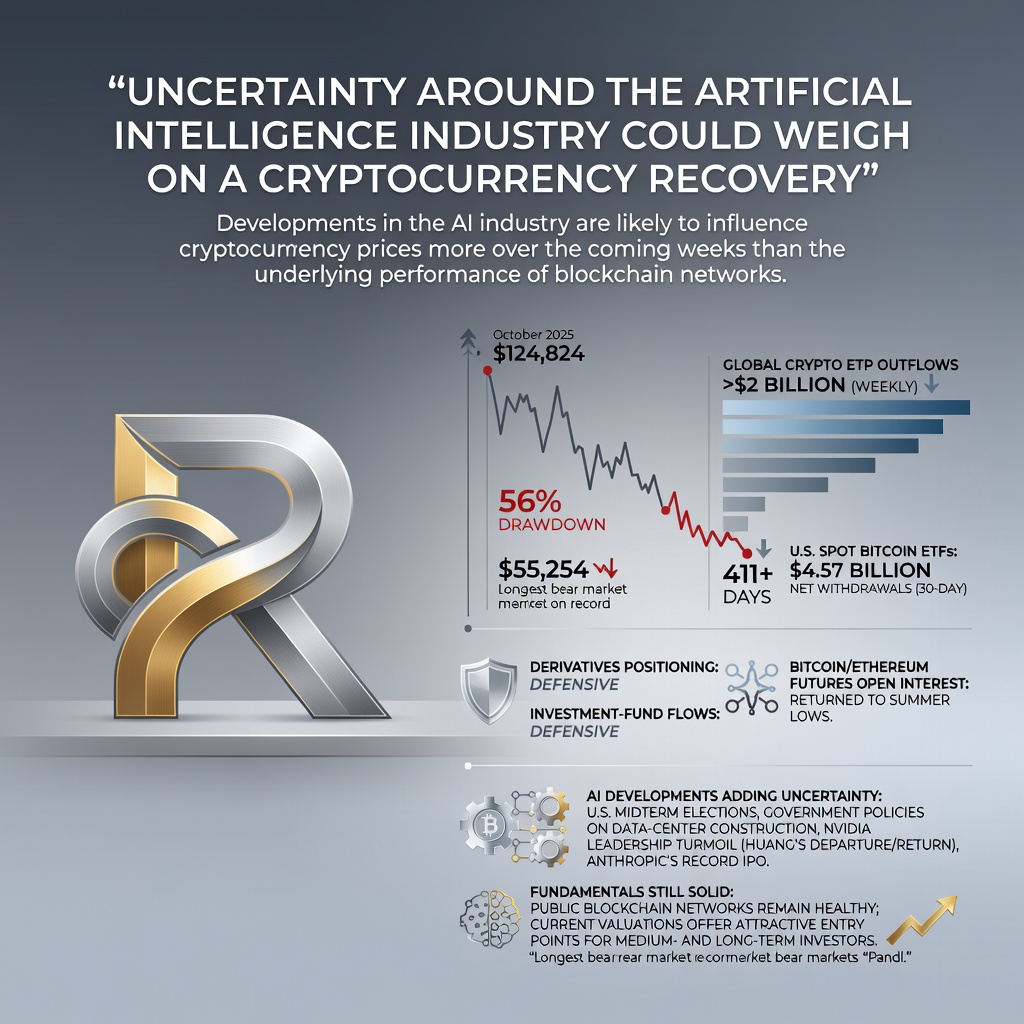
In a Nov. 23 research report, head of research Zach Pandl said developments in the AI industry are likely to influence cryptocurrency prices more over the coming weeks than the underlying performance of blockchain networks. The comment followed a volatile stretch in which Bitcoin fell to approximately $55,000 on Nov. 21, below its prior bear-market low of $58,000 on June 30, before recovering to around $62,000 by the time of the report. Grayscale still described derivatives positioning and investment-fund flows as defensive.
Longest bear market in Grayscale’s records
Under the asset manager’s historical cycle analysis, the current Bitcoin bear market has lasted at least 411 days, the longest downturn on record in that framework. The drop from the October 2025 peak of $124,824 to an intraday low of $55,254 is a drawdown of approximately 56 percent. Grayscale said that is the shallowest decline among the five major bear markets it examined back to 2011.
Outflows and defensive positioning
Global cryptocurrency exchange-traded products recorded more than $2 billion in outflows over the previous week, while significant stablecoin redemptions pointed to capital leaving the market. U.S. spot Bitcoin ETFs recorded $4.57 billion in net withdrawals over a 30-day period, according to estimates from 10x Research. BlackRock’s iShares Bitcoin Trust posted its largest daily outflow on Nov. 20, when investors withdrew $544.7 million.
Open interest in Bitcoin and Ethereum futures contracts had returned to levels last seen during the summer. Grayscale’s analysis of Bitcoin options found investors paying considerably higher premiums for put options that hedge against further declines. Implied volatility on shorter-dated options was substantially higher than on longer-dated contracts, which the firm read as particular concern about immediate price moves.
AI developments Grayscale is watching
Pandl identified several developments since the start of November that have added uncertainty around AI investment. They include the outcome of the U.S. midterm elections and questions over how future government policies could affect data-center construction. Cryptocurrencies have already sold off alongside technology stocks this month. On Nov. 5, Bitcoin lost approximately 5.5 percent as the Nasdaq fell by a similar percentage and semiconductor stocks dropped around 12 percent.
Grayscale also highlighted leadership turmoil at Nvidia, whose shares were considerably volatile after Jensen Huang’s departure and subsequent return. Bitcoin briefly climbed above $64,000 after Huang’s reinstatement as CEO on Nov. 23, as investors moved back into technology stocks following the prior week’s selloff. The recovery was short-lived. Bitcoin fell below $60,000 during Asian trading hours on Tuesday amid weak spot demand and another $569.74 million in daily withdrawals from U.S. spot Bitcoin ETFs.
Among other items, Pandl pointed to recent service disruptions affecting the Federal Aviation Administration, Microsoft Outlook, major financial institutions, and the National Security Agency. He also noted investor attention on AI companies entering public markets and described Anthropic’s initial public offering as one of the largest on record.
Fundamentals still described as solid
Despite the near-term caution, Grayscale said public blockchain networks remain fundamentally healthy and that current valuations could suit investors with longer holding periods. Pandl wrote: “We believe public blockchain fundamentals look solid, and that current valuations offer an attractive entry point for investors with medium- and long-term holding periods.”
The firm expects public blockchains to play an important role in financial systems built around artificial intelligence, alongside potential productivity gains from the technology. Its team examined related questions in earlier notes. An Oct. 8 research note looked at how cheaper, autonomous AI agents could affect demand for computing resources. A separate report on Oct. 20 maintained that demand for computing resources was likely to persist even as share prices of companies in the sector declined.