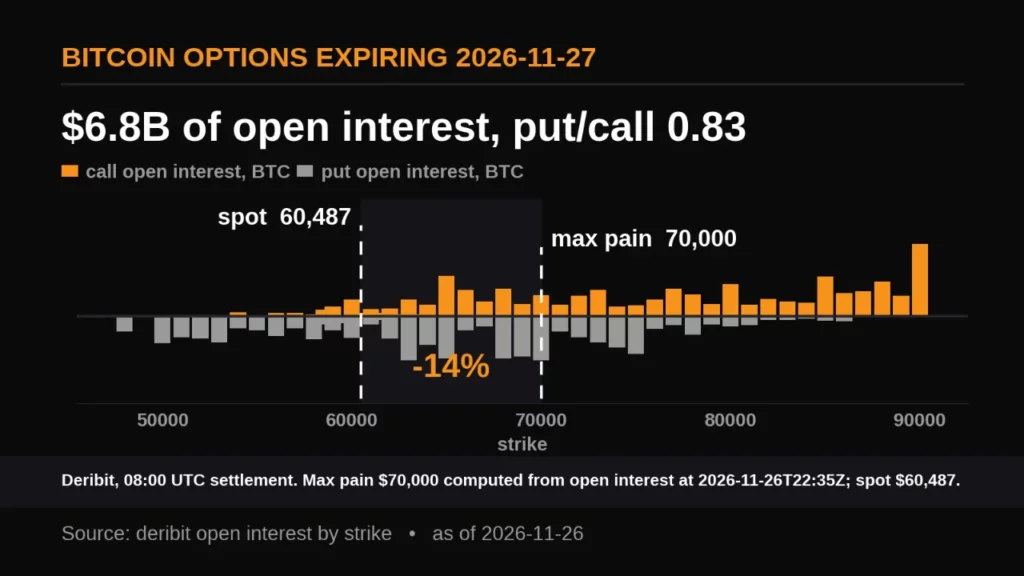
Bitcoin traded near $61,700 early on November 27, 2026, ahead of a Deribit options expiry scheduled for 08:00 UTC. Contracts worth $6.8 billion were due to expire, representing 25.4% of total Bitcoin options open interest, according to CryptoQuant contributor The Daily Digits. The largest concentration was at the $65,000 strike, where most contracts were puts.
Bitcoin ranged from $59,880 to $61,740 over the preceding 24 hours, according to crypto.news market data. Its recovery broadly tracked a 0.85% rise in the wider crypto market, but left Bitcoin nearly 51% below its October 2025 high of $126,198.
What the options book showed
Contracts at the $65,000 strike covered 5,428 BTC, worth about $328 million. With Bitcoin trading below $65,000, puts at that strike had intrinsic value, though a buyer’s net result would depend on the settlement price and the premium paid.
The Daily Digits calculated a separate figure of $70,000 for “maximum pain,” about 16% above the $60,487 Bitcoin price used in the analysis. That figure identifies the settlement price at which outstanding options would pay holders the least in aggregate. It is not a forecast. The analyst also reported a December monthly risk reversal of negative 7.22 volatility points, indicating that traders were paying more for downside protection than for upside exposure.
In the futures market, CoinGlass recorded about $47 million in Bitcoin short liquidations over 24 hours, against $18.5 million in long liquidations. Shorts accounted for roughly 71% of the reported $66.43 million total. Buying to close those positions may have contributed to the rebound, but the figures do not establish how much of the move it explained.
ETF withdrawals and stablecoin supply
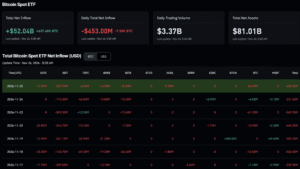
US spot Bitcoin ETFs recorded $5.39 billion in net outflows in November through November 25, according to SoSoValue. Net withdrawals rose from $231.56 million on November 24 to $453.12 million on November 25. The funds held $72.03 billion in combined net assets and retained $51.59 billion in cumulative net inflows since launch. After the Thanksgiving closure, trading was scheduled to resume on November 27 for a shortened session ending at 1 p.m. Eastern time.
Two stablecoin measures also showed a contraction, over different periods. CryptoQuant contributor CryptoZeno reported that stablecoin market capitalization had fallen about 12% over 30 days, reducing capital readily transferable across exchanges and decentralized finance applications. Separately, 21Shares measured a $10.7 billion supply decline over 18 days, the largest dollar reduction over such a period since the Terra collapse in 2022.
Price levels in context
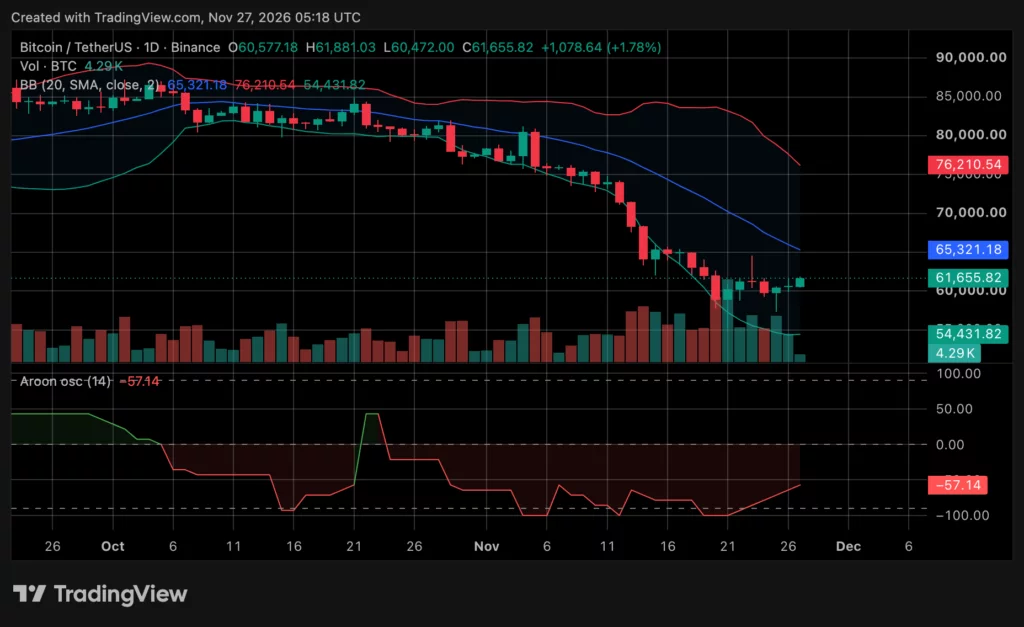
In a November 25 assessment, Bitfinex analysts outlined a possible pre-expiry range of $56,300 to $61,400, with downside risk to $55,501. The early November 27 price of $61,700 was already above that range. On the daily chart, Bitcoin remained below its 20-day moving average near $65,321, while $60,000 marked a potential support level.
Looking beyond the November expiry, The Daily Digits put Bitcoin’s realized price, a measure of its on-chain cost basis, at about $53,100, down from $54,100 a month earlier. In the analyst’s view, a daily close below that level before the December 25 expiry would lend support to traders’ continued demand for downside protection.