How do you retire a privacy system while it still holds users’ funds? On November 26, 2026, Zcash development team Zakura proposed closing its older Sapling shielded pool to new deposits and encouraging holders to move their ZEC to Ironwood, a newer pool. The proposal would accelerate Sapling’s retirement. It was not an emergency shutdown or a response to a confirmed attack.
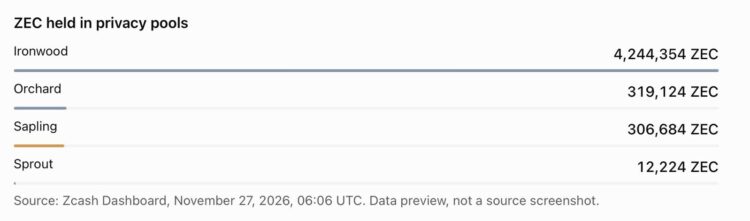
Zakura estimated that Sapling held about 400,000 ZEC. At 06:06 UTC on November 27, the Zcash Dashboard showed approximately 306,684 ZEC in the pool. The later snapshot was below Zakura’s rounded estimate, but the two figures do not establish that users moved funds in response to the proposal.
Two distinct risks for Zcash
Sapling lets users transact without disclosing certain transaction details. Zakura’s immediate concern was that mathematical advances at artificial intelligence laboratories might undermine assumptions behind Sapling’s proof system. Those advances remain speculative and unverified. Zakura said further emergency measures could be considered if credible evidence emerged. Its proposal follows Zcash’s NU7 upgrade, which improved transaction speed and continued the shift away from older infrastructure.
A separate effort, Shielded Labs’ Epoch project, addresses the longer-term risk from quantum computers. In its first technical update on November 25, the team said it was evaluating two approaches and expected to choose one by the end of January 2027 if research stayed on track. One constraint is proof size: larger proofs mean more data to transmit, verify and store, with implications for transaction capacity and cost. Ironwood includes features intended to support a future recovery mechanism, but it does not make Zcash quantum-resistant.
What Bitcoin’s 7.23 million BTC exposure estimate measures
Bitcoin faces a different problem. Its signatures let the network verify a payment without learning the private key that authorized it. A sufficiently capable quantum computer could use an algorithm introduced by mathematician Peter Shor in 1994 to derive a private key from an exposed public key. Someone other than the owner could then sign a transaction that the network would accept.
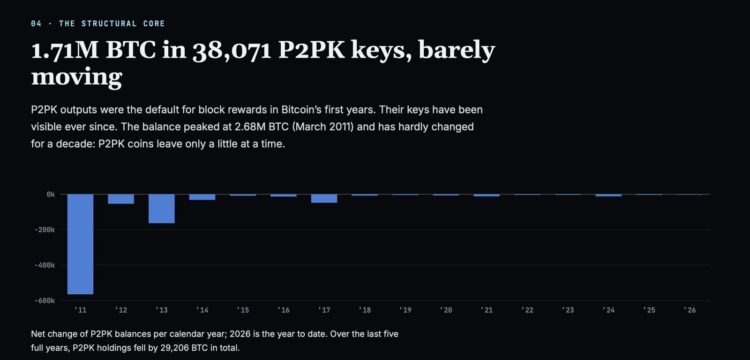
In a November 25 snapshot, The Quantum Ledger identified 7.23 million BTC, or 35.9% of issued supply, associated with public keys or spending scripts already visible on-chain. Its estimate had two components:
- 1.94 million BTC was exposed by the design of the transaction output. Some early Bitcoin outputs, for example, displayed the public key directly.
- 5.29 million BTC was associated with addresses that had previously revealed relevant spending information.
Glassnode identified 6.04 million BTC in May 2026 under a different classification framework. The figures therefore cannot be read as a like-for-like increase in exposure. Neither is an estimate of losses: both describe coins that could be at risk under a future attack scenario.
The migration problem for wallets and custodians
Bitcoin proposal BIP-360 would introduce an output format designed to reduce certain forms of public-key exposure. A separate draft, BIP-361, explores phasing out vulnerable signature schemes once suitable alternatives exist. Neither proposal is an activated Bitcoin upgrade.
Even if new protections become available, moving existing coins requires access to the keys that control them. Owners who have lost their keys cannot migrate their funds. Restricting spending from old outputs could prevent future theft, but it could also lock out legitimate owners who still hold their keys. Ethereum faces a broader infrastructure task because signatures secure not only wallets but also validators, staking arrangements and institutional custody.
The US National Institute of Standards and Technology has developed post-quantum cryptographic standards, but adopting new cryptography across a network is a separate undertaking. According to Coinbase Institute research, a quantum computer capable of breaking widely used cryptocurrency signatures does not yet exist, and there is no reliable date for one. Upgrading blockchains, wallets and custody systems could itself take years. That difference in timing, rather than evidence of a successful attack, is the reason developers are planning migrations now.