How much of its Bitcoin reserve will MARA Holdings need to turn into cash before its power and data-center projects generate revenue? As reported on November 18, 2026, the miner had disclosed sales of about 40,581 BTC for roughly $3 billion during the year through its November 9 third-quarter results. The sales mark a change from its earlier policy of retaining all the Bitcoin it mined.
From building a reserve to funding the business
In July 2024, MARA announced a $100 million Bitcoin purchase and a policy of retaining all mined BTC, while buying more when it chose to. Its holdings reached 44,893 BTC by year-end. In the fourth quarter alone, it used convertible-debt proceeds to buy 15,574 BTC—more than six times what it mined that quarter.
MARA began allowing sales of newly mined Bitcoin in 2025, selling about 4,076 BTC that year while ending it with 53,822 BTC. In 2026, it extended sales to Bitcoin already held on its balance sheet. Between March 4 and 25, it sold 15,133 BTC for about $1.1 billion, then paid roughly $913 million to repurchase two series of zero-coupon convertible notes with approximately $1 billion in principal. That reduced outstanding principal and potential dilution from future conversion.
In the first nine months of 2026, MARA mined 6,916 BTC and sold about 26,984 BTC—nearly four times its production. Its holdings stood at 34,012 BTC at September 30, down about 37% from year-end; 14,752 BTC was freely available, with the remainder pledged or lent. A further sale of about 13,597 BTC followed the quarter-end. For funding decisions, the distinction between total holdings and Bitcoin available to use matters.
The Long Ridge financing sequence
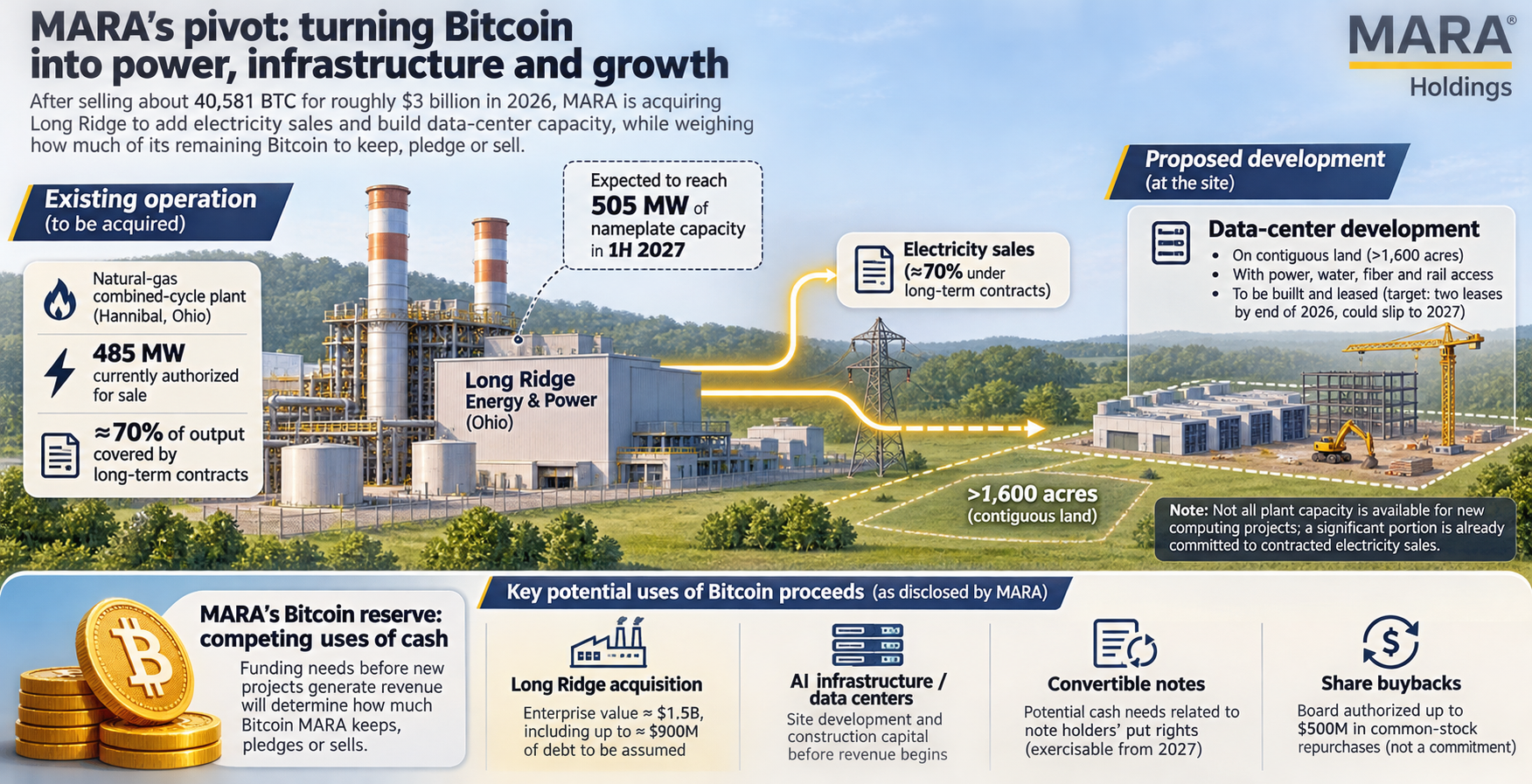
MARA announced in late April that it planned to acquire Long Ridge Energy & Power from FTAI Infrastructure at an enterprise value of about $1.5 billion, including up to approximately $900 million of debt it expected to assume. On August 4, it arranged $750 million in Bitcoin-backed loans with Coinbase Credit and Two Prime Lending, initially pledging 18,750 BTC. Of the proceeds, $600 million was new funding and $150 million refinanced an existing loan.
MARA said Bitcoin traded at about $64,000 when it borrowed. The Two Prime loan carried a 7.65% annual interest rate; the Coinbase loan had a floating rate. Borrowing against BTC provided dollars without issuing shares or immediately selling the collateral, but exposed MARA to interest costs and potential collateral calls if the price fell.
After September 30, MARA sold 13,597 BTC at an average price of about $81,039, raising approximately $1.1 billion. It used $750 million to repay both loans in full and recovered the 17,477 BTC still pledged against them. Management estimated a roughly $170 million net benefit from borrowing first and selling later. That outcome depended on the price movement: a decline could instead have brought collateral pressure alongside a lower sale price.
The US Federal Energy Regulatory Commission approved the acquisition on November 4. At its November 9 results announcement, MARA still expected closing in the following weeks. Repaying MARA’s acquisition loans did not extinguish Long Ridge’s existing debt, which remained part of the proposed transaction terms.
Power assets and the cash required to develop them
Long Ridge’s operating asset is a natural-gas combined-cycle plant in Hannibal, Ohio, with 485 megawatts currently authorized for sale. MARA expected it to reach 505 MW of nameplate capacity in the first half of 2027. According to the company, long-term contracts already cover about 70% of its output. The proposed purchase also includes more than 1,600 contiguous acres with power, water, fiber and rail access, near a roughly 200 MW MARA facility.
If the deal closes, the plant could provide electricity-sales revenue while MARA develops data-center space. Its contracted output also means nameplate capacity should not be read as power freely available for new computing projects. Separately, MARA has a potential development of up to 2 gigawatts in Matagorda County, Texas, still subject to grid-connection and other approvals. It hoped to sign two data-center leases by the end of 2026, while acknowledging that signing could slip into 2027.
MARA’s majority-owned subsidiary Exaion has also signed a four-year, $79 million GPU-compute contract with its first US customer. That is a different revenue model from leasing data-center space. The more than $3 billion in potential opportunities MARA disclosed at the same time would still need to become binding orders.
Mining remains part of the operation while new facilities are developed. MARA mined 2,247 BTC in the third quarter, about 5% more than a year earlier, but revenue fell 35% to roughly $164 million. Net income of about $632 million included an approximately $885 million fair-value gain on digital assets. That accounting gain is distinct from the cash needed for construction, interest and acquisitions.
Competing uses for the remaining Bitcoin
On November 9, MARA’s board authorized up to $500 million in common-share repurchases; the timing and amount of any purchases depend on market conditions, the share price and available funds. In its shareholder letter, MARA identified AI infrastructure investment, convertible-note holders’ put rights exercisable from 2027, and possible buybacks as potential reasons to raise cash through future Bitcoin sales. The authorization is not a commitment to spend the full amount.
Peers illustrate different choices. American Bitcoin sold some newly mined BTC for operating costs in the third quarter but increased its holdings from about 8,002 to 8,427 BTC. Riot Platforms sold 20,264 BTC for roughly $1.5 billion in the first nine months of 2026, mainly for data-center development. IREN reported $200 million in AI-cloud revenue and $28 million in mining revenue for the quarter ended September 30, after its Microsoft-facing Horizon 1 project entered service.
For MARA, the operational questions are whether Long Ridge’s electricity sales can cover operating and financing costs after closing, and how much construction cash its data centers require before they begin collecting revenue. Those answers will shape how much of its Bitcoin reserve it keeps, pledges or sells.