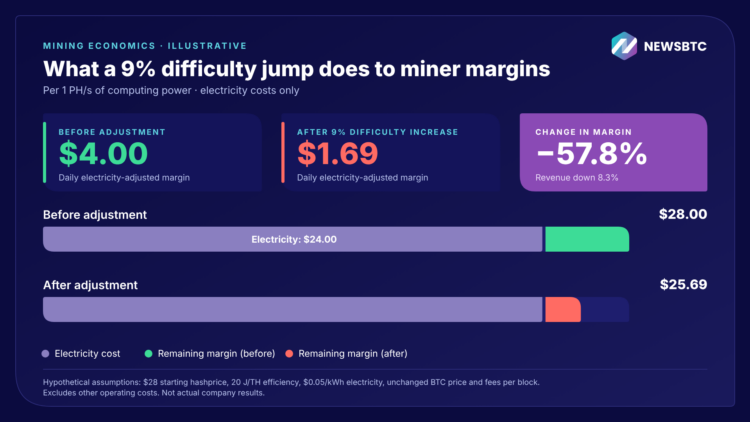
For a Bitcoin miner paying $0.05 per kilowatt-hour and running machines rated at 20 joules per terahash, the next difficulty adjustment could cut the daily margin after electricity from about $4 to $1.69 per petahash per second (PH/s). The power bill would stay the same; the machines would earn less BTC.
As of November 26, 2026, network estimates pointed to a difficulty increase of about 9% at block 977,760, expected on November 27. That would take difficulty from 134.82 trillion to roughly 147 trillion, reversing much of the 9.13% reduction on November 14. Bitcoin adjusts difficulty every 2,016 blocks to keep the average interval near ten minutes. Blocks had been arriving faster than that target during the period, but the size of the adjustment was not yet final.
What changes for a miner running 1 PH/s
A 9% increase in difficulty would reduce expected BTC output per unit of computing power by about 8.3%, not 9%. A fleet expected to earn 1 BTC over a given period would instead expect about 0.917 BTC over the same period, with its hashrate and average reward per block unchanged.
Mining industry trackers put hashprice—the expected daily revenue from a given hashrate—at about $28 per PH/s. At the example fleet’s efficiency of 20 J/TH, sustaining 1 PH/s draws 20 kilowatts. That amounts to 480 kilowatt-hours per day, or $24 at the assumed power rate.
| Daily economics for 1 PH/s | At November 26 hashprice | With 9% higher difficulty |
|---|---|---|
| Expected gross revenue | $28.00 | $25.69 |
| Electricity cost | $24.00 | $24.00 |
| Revenue after electricity | $4.00 | $1.69 |
The projection holds Bitcoin’s dollar price and average transaction fees per block constant. The $1.69 is not net profit: it still has to cover hosting, cooling, maintenance, financing and other costs.
The network adjustment is uniform; fleet costs vary
Miners with efficient machines and inexpensive power may be able to keep operating through the adjustment. For a fleet using more electricity per unit of hashrate, switching off older machines may make more sense. Some established operators are also redirecting data-center infrastructure toward AI and high-performance computing, an option not available to every miner.
A narrower margin does not establish that miners are selling more BTC. Some routinely sell production; others hold reserves, seek financing or cut expenses. Miner balances, transfers to exchanges and company treasury disclosures offer better evidence of selling than a difficulty estimate alone.